Mount Kilimanjaro: A Complete Guide to Climbing Africa’s Highest Mountain
At 5,895 metres above sea level, Mount Kilimanjaro rises dramatically above the plains of northern Tanzania. Its snow-capped summit, Uhuru Peak, is the highest point in Africa and one of the world’s most recognisable mountain destinations.
But climbing Kilimanjaro is not simply about reaching the summit.
It is a journey through several distinct ecological zones, from cultivated foothills and tropical forest to high-altitude moorland, alpine desert, and the glacial summit zone. With every day, the landscape changes, and so does the challenge.
For travellers willing to move slowly, respect the altitude, and embrace the mountain’s rhythm, climbing Kilimanjaro offers one of Tanzania’s most memorable adventures.
Why Climb Mount Kilimanjaro?
Kilimanjaro is unusual among the world’s highest mountains because its standard trekking routes do not require technical mountaineering skills.
You do not need to be an experienced rock climber or mountaineer. What matters more is physical preparation, altitude acclimatisation, patience, and determination.
The mountain’s accessibility allows properly prepared trekkers to experience an extreme high-altitude environment without requiring ropes, technical climbing equipment, or advanced mountaineering experience on most routes.
However, accessible does not mean easy.
The final ascent is physically demanding, and altitude is the primary challenge.
The Journey to Uhuru Peak
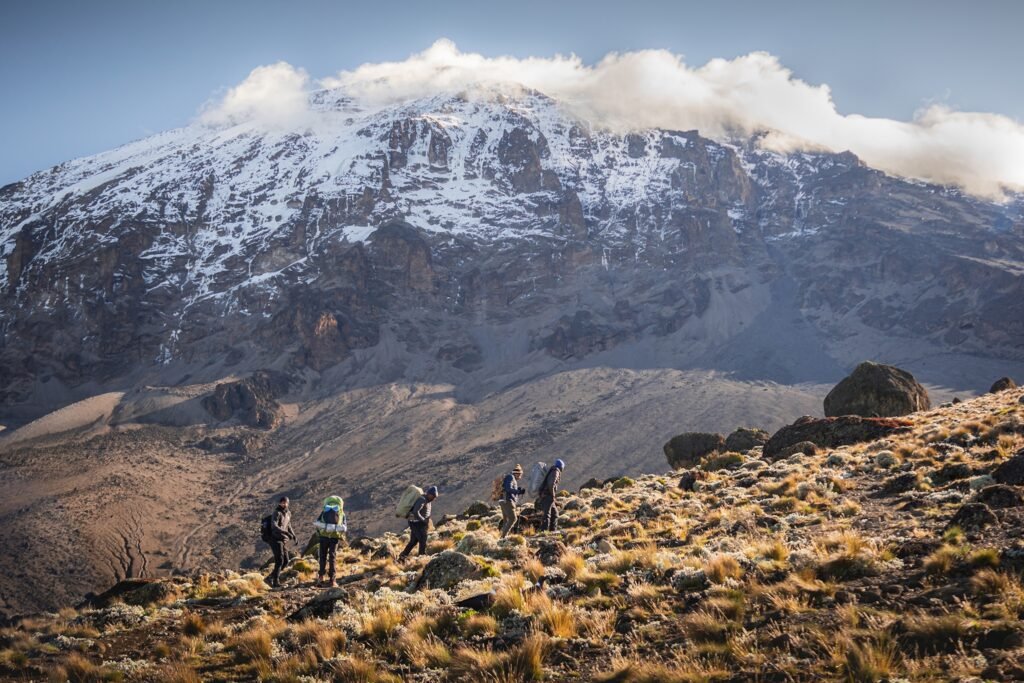
A Kilimanjaro climb takes you through five major ecological zones, each with its own climate, vegetation, and landscape.
Cultivation Zone
The lower slopes are surrounded by farmland and villages, reflecting the communities that have lived around Mount Kilimanjaro for generations.
As the climb begins, the landscape is relatively warm and fertile before gradually transitioning into the mountain’s natural forest zone.
Montane Forest
Higher up, the landscape becomes dense and green.
Tall trees, mosses, ferns, and wildlife create a dramatic contrast with the exposed terrain found at higher elevations. The forest also provides a completely different atmosphere from the open landscapes visible later in the climb.
Heath and Moorland
The forest gradually gives way to open vegetation, giant heathers, grasses, and expansive mountain views.
The landscape becomes less dense as elevation increases, and the changing vegetation provides a visible reminder of how dramatically conditions change on Kilimanjaro.
Alpine Desert
At higher elevations, vegetation becomes increasingly sparse.
Rocks, volcanic terrain, and intense sunlight dominate the landscape. Temperatures can vary significantly between daytime and nighttime, creating a harsh environment where only specialised vegetation can survive.
Arctic Summit Zone
Above approximately 5,000 metres, the environment becomes extremely harsh.
Temperatures can fall well below freezing, atmospheric pressure is much lower, and vegetation almost disappears. The landscape becomes increasingly barren as you approach the summit.
Eventually, the trail leads toward Uhuru Peak at 5,895 metres.
Standing at the summit, with the African plains far below, is the culmination of the journey.
Which Kilimanjaro Route Should You Choose?
Mount Kilimanjaro has several established routes, each offering different combinations of scenery, duration, difficulty, traffic levels, and acclimatisation opportunities.
Machame Route
Often called the “Whiskey Route,” Machame is one of the most popular Kilimanjaro routes.
It offers varied scenery and a challenging but well-established approach to the mountain. Its route profile provides opportunities for acclimatisation when completed over an appropriate number of days.
Best for: Trekkers looking for varied scenery, physical challenge, and a classic Kilimanjaro experience.
Lemosho Route
The Lemosho Route approaches Kilimanjaro from the west and is generally considered one of the mountain’s more scenic routes.
Its longer itineraries provide additional time for acclimatisation and allow trekkers to experience more of the mountain’s western landscape.
Best for: Trekkers who prefer a longer, more gradual climb with varied scenery.
Northern Circuit Route
The Northern Circuit takes a longer route around the quieter northern side of Mount Kilimanjaro.
Its extended duration provides excellent opportunities for acclimatisation and allows trekkers to experience a less frequently travelled section of the mountain.
Best for: Travellers prioritising acclimatisation, scenery, duration, and a quieter route.
Marangu Route
Known as the “Coca-Cola Route,” Marangu is the only major Kilimanjaro route where trekkers sleep in mountain huts rather than tents.
The route is comparatively direct and has a different accommodation style from the other main routes.
Best for: Travellers who prefer hut accommodation and a more straightforward route.
Rongai Route
The Rongai Route approaches Kilimanjaro from the northeastern side, near the Kenyan border, and is generally quieter than Machame and Marangu.
It provides a different perspective of the mountain and can be appealing to trekkers looking for a less crowded approach.
Best for: Travellers looking for a quieter route and different mountain scenery.
How Many Days Does It Take to Climb Kilimanjaro?
Most successful Kilimanjaro climbs take approximately six to nine days, depending on the route and itinerary.
Although shorter itineraries exist, spending more days on the mountain generally provides greater opportunity for your body to adapt to increasing altitude.
A longer route is therefore not simply about adding days to your holiday. It can improve the quality of the climb by allowing a more gradual ascent and better acclimatisation.
For this reason, choosing a route based solely on the lowest price or shortest duration can be a poor strategy.
On Kilimanjaro, time is an advantage.
When Is the Best Time to Climb Mount Kilimanjaro?
Kilimanjaro can be climbed throughout much of the year, but the most popular trekking periods generally coincide with the mountain’s drier seasons.
January–February
These months are generally dry and relatively warm, making them a popular period for trekking.
March–May
The long rains can make trails wetter and conditions less predictable. Some routes may become more challenging during periods of heavy rainfall.
June–October
This is another popular trekking period, with generally favourable conditions and cooler temperatures.
November–December
The short rains can bring wetter conditions, although climbing remains possible.
If your priority is favourable trekking conditions, the drier months are generally the preferred choice.
What Makes Kilimanjaro Summit Day Different?
Summit day is unlike the previous days of the trek.
Trekkers typically begin the final ascent around midnight or during the early hours of the morning. This allows them to reach the summit around sunrise, when the mountain and surrounding landscapes can be particularly spectacular, while also beginning the descent before the day becomes too advanced.
The pace is deliberately slow.
Step by step.
Breath by breath.
At this altitude, even simple movement requires significantly more effort.
The final approach eventually reaches Stella Point on the crater rim before continuing towards Uhuru Peak.
When you finally reach the summit, the achievement is physical but also psychological.
You have spent days climbing toward a point that, from the plains below, appears impossibly distant.
Why Acclimatisation Is Important on Kilimanjaro
Altitude is one of the greatest challenges on Kilimanjaro.
As elevation increases, atmospheric pressure decreases, meaning each breath provides less oxygen than it would at sea level. This can cause altitude-related symptoms such as:
- Headache
- Fatigue
- Dizziness
- Loss of appetite
- Nausea
- Shortness of breath
This is why experienced mountain teams emphasise gradual ascent and proper acclimatisation.
The principle often described by guides as “pole pole,” meaning “slowly, slowly,” is more than a memorable phrase. Moving at a controlled pace helps trekkers manage the physical demands of increasing altitude.
Altitude symptoms should always be taken seriously. Severe or worsening symptoms require immediate descent and professional medical attention.
What Should You Pack for Kilimanjaro?
A Kilimanjaro packing list needs to account for dramatically changing temperatures and conditions throughout the climb.
Essential categories include:
- Layered clothing
- Waterproof jacket and trousers
- Warm insulating jacket
- Thermal base layers
- Hiking trousers
- Comfortable trekking boots
- Warm gloves
- Hat and sun protection
- Headlamp
- Sleeping bag suitable for cold conditions
- Water bottles or hydration system
- Sunglasses
- Sunscreen
- Personal medication and first-aid supplies
- Backpack and waterproof protection
The mountain can be warm in the lower forest and freezing near the summit.
Layering is therefore more practical than relying on one extremely heavy jacket. It allows you to adjust your clothing as temperatures and activity levels change throughout the climb.
Combining Kilimanjaro With a Tanzania Safari
One of the advantages of climbing Mount Kilimanjaro in Tanzania is the opportunity to combine the mountain with a safari.
You can begin among the forests and volcanic slopes of Kilimanjaro, reach the highest point in Africa, and then descend into the savannah to encounter elephants, lions, giraffes, and other wildlife.
A longer Tanzania journey could combine:
Kilimanjaro → Serengeti → Ngorongoro → Zanzibar
Each stage offers a completely different experience.
The mountain provides challenge.
The safari provides wilderness.
The Indian Ocean provides recovery and relaxation.
Together, they create a remarkably complete Tanzania journey.
Is Climbing Mount Kilimanjaro Worth It?
Kilimanjaro is demanding, but its appeal goes beyond reaching the summit.
You experience multiple ecosystems within a matter of days, sleep beneath enormous African skies, walk through landscapes that change dramatically with altitude, and ultimately stand at the highest point on the African continent.
The mountain does not reward speed.
It rewards preparation, patience, and consistency.
Perhaps that is what makes climbing Kilimanjaro so compelling.
You do not reach the summit by rushing towards it. You reach it one deliberate step at a time.