The Great Migration in Tanzania
Every year, enormous herds of wildebeest move across the Serengeti ecosystem in one of the largest terrestrial wildlife migrations on Earth.
However, the Great Migration is not simply a journey from one destination to another. It is an ancient ecological cycle shaped largely by rainfall, fresh grass, water availability, and the changing conditions of the Serengeti ecosystem.
Why the Wildebeest Migrate
The movement of the herds is closely connected to the availability of food and water.
Following the short rains, the southern Serengeti develops nutrient-rich grasslands. These fresh grazing areas attract huge concentrations of wildebeest, zebra, and other herbivores.
As environmental conditions change, the herds gradually begin moving in search of better grazing and water, creating the continuous cycle that defines the Great Migration.
The Calving Season in the Serengeti
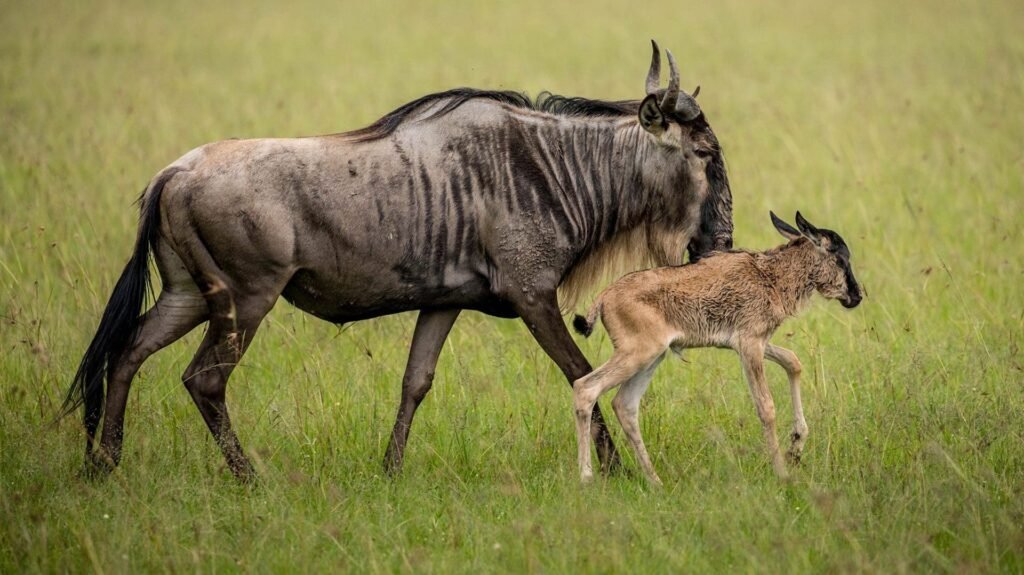
Around January and February, large numbers of wildebeest give birth in the southern Serengeti and surrounding areas.
The abundance of fresh grass provides mothers with access to the nutrients they need during this demanding period. The concentration of young animals also creates one of the most dramatic predator-prey interactions of the migration, as lions, cheetahs, hyenas, and other predators take advantage of the abundance of vulnerable newborns.
The Herds Move North and West
As the southern grasslands become less nutritious and environmental conditions change, the herds begin moving north and west.
Their route takes them through different areas of the Serengeti ecosystem as they continue searching for fresh grazing and water. The exact timing and location of the herds can vary from year to year because their movements are strongly influenced by rainfall and local conditions.
Eventually, many of the animals reach the northern Serengeti and the Mara River region.
The Dangers of the Great Migration
The Great Migration is a difficult and dangerous journey.
Young wildebeest can fall victim to predators, while rivers create additional risks. Crossing deep or fast-moving water can result in drowning, while Nile crocodiles may prey on animals attempting to cross.
Exhaustion, injuries, disease, competition for resources, and predation all contribute to the dangers faced by the migrating herds.
Despite these challenges, the migration continues year after year.
How Millions of Animals Know Where to Go
One of the most remarkable aspects of the Great Migration is that there is no single leader directing millions of animals.
Instead, the movement emerges from the individual responses of animals to changing environmental conditions. As rainfall alters the availability of grass and water, different groups respond to these conditions and gradually move in the same general direction.
What appears to be a coordinated journey is therefore the result of countless individual decisions shaped by instinct and the environment.
The Great Migration as an Ecological Cycle
The Great Migration is more than a spectacular wildlife event.
It demonstrates how an entire ecosystem responds to the movement of water, nutrients, predators, and prey. Rainfall influences vegetation, vegetation influences herbivore movements, and the concentration of herbivores affects predators and other species throughout the ecosystem.
The result is a continuous natural cycle connecting the grasslands of the Serengeti with the wider Mara ecosystem.